
Is your office quietly killing good ideas?
Creative culture isn’t free snacks or open floor plans.
It’s a deliberate system that gives people psychological safety, autonomy, and moments designed to spark experiments.
When leaders mix cross-team collaboration, small budgets for prototypes, and regular rituals like show-and-tells, ideas move faster and people stay longer.
This post lays out what modern creative culture actually looks like, the metrics that prove it boosts velocity and retention, and a practical 90-day roadmap to start building workplaces where innovation thrives.
Defining a Modern Creative Culture in Today’s Workplace

A creative culture is an environment where employees can do their best work. It’s built on mutual respect, real energy, and a shared commitment to keeping that energy alive. It puts people at the center of problem solving, cares about the folks who’ll use what you make, and obsesses over the tiny details that shape how good the final product actually is. Static corporate setups don’t cut it. Creative cultures actively create moments where ideas can show up, change shape, and turn into something real.
Inspiration comes from two different places. Sometimes it’s spontaneous—random conversations, something you noticed outside the office, an unexpected encounter that makes you think differently. Other times it’s deliberate. Every detail gets planned to trigger specific emotions and thoughts. Both feed creative output, just in different ways. The best workplaces mix them on purpose.
Cafés turned out to be surprisingly useful for understanding curated creative spaces. Writer Conor Friedersdorf over at The Atlantic calls it “just enough distraction.” There’s ambient noise and visual stuff happening, but not so much that it overwhelms you. The seating, the random objects on shelves, the ritual of ordering a crafted drink—it all combines to trigger emotional cues that help you focus on project work. Lots of creative teams treat cafés as extensions of their workspace now, not distractions from it.
Employees working in strong creative cultures consistently want:
- Psychological safety: you can pitch ideas without worrying someone’s gonna mock you or punish you for it.
- Autonomy: control over how, when, and where you solve problems.
- Collaborative energy: being close to people who bring different skills and see things differently than you do.
- Micro-detail attention: environments where small design choices reflect bigger care and intention.
- Empathy for users: everyone’s committed to understanding the people who’ll experience what you’re building.
- Curated stimuli: thoughtfully chosen objects, layouts, and routines that keep creative thinking fresh.
Core Characteristics That Shape a Strong Creative Culture

The traits that make creative workplaces work show up consistently across industries and company sizes. These aren’t values you stick on a wall. They’re behaviors you can observe, rituals you can repeat, and investments you can measure. When leadership commits to them, teams notice immediately in how free they feel to experiment, the conversations that happen without planning, and how fast prototypes move from sketch to test.
Creative cultures give teams ownership over how problems get solved, not just which problems they tackle. They build cross-functional mixing into workflows so designers, engineers, product managers, and customer-facing staff work side by side during ideation and iteration. Rituals provide scaffolding. Weekly sprints, monthly show-and-tell sessions, quarterly retrospectives—they keep creativity from turning random or chaotic.
High-performing creative workplaces share these hallmarks:
- Psychological safety where intelligent failure gets celebrated, not punished.
- Autonomy over project approach, work location, and daily rhythms.
- Cross-functional collaboration baked into team composition and workflows.
- Regular creative rituals that carve out predictable time and space for experimentation.
- Explicit tolerance for failure, backed by leadership recognition of 2–3 “smart misses” each quarter.
- Dedicated experimentation budgets, typically 1–5% of revenue, ring-fenced from operational costs.
- Community energy fostered through shared spaces, communal tool walls, and intentional placement of curated objects.
- Workspace design that emphasizes placement with purpose, from seating arrangements to artifact displays that trigger positive emotional responses.
Proven Creative Culture Case Studies From Leading Companies

Real-world examples show how creative culture principles translate into systems you can repeat. Four companies—across manufacturing, technology, software, and entertainment—demonstrate different models for sustaining innovation at scale.
3M
3M’s “15% rule” remains one of the longest-running creative culture programs in corporate history. Employees can devote 15% of their work time to independent projects unrelated to their core responsibilities. This policy produced Post-it Notes, masking tape innovations, and dozens of other market-defining products. The rule works because it normalizes experimentation as part of the job, not a side activity squeezed into evenings or weekends. Leadership doesn’t micromanage how that 15% gets spent. They trust employees to follow curiosity and surface findings when they’re ready.
Google’s historical “20% time” practice became famous for producing Gmail, Google News, and AdSense—products that collectively generate billions in revenue. Employees could allocate one full day per week to side projects, with minimal approval required to start. The program’s evolved and participation varies across teams, but its legacy shaped how Silicon Valley approaches time-based innovation policies. The key was structural permission. Engineers didn’t need to ask for time to tinker. The calendar already held space for it.
Adobe
Adobe Kickbox offers a physical innovation kit to any employee who wants to test an idea. Each box includes a $1,000 prepaid card, project templates, and a step-by-step process guide. The seed funding removes the first barrier to prototyping, which is budget approval. The structured methodology reduces the intimidation of starting from scratch. Employees track experiments, document learnings, and present findings regardless of commercial outcome. The program’s generated hundreds of validated ideas and reinforced a bias toward action over endless planning.
Pixar
Pixar, which became an independent studio in 1986, built its creative culture around the Braintrust. It’s a structured peer-review process where directors and creative leads critique films in progress. The rules are strict. Feedback must be candid, but the director retains final creative control. This balance between rigorous critique and individual ownership has sustained Pixar’s output quality for decades. The Braintrust doesn’t just improve films. It models how to give and receive feedback in ways that strengthen ideas rather than shutting them down.
Heritage Bicycles General Store in Chicago’s Lakeview neighborhood offers a physical case study in curated creative environments. As the first custom bike manufacturer in the city since 1982, the shop blends craft, retail, and café functions in a single open floor plan. Communal seating, exposed bike-building stations in the rear, and intentionally placed objects—a vintage typewriter, a reclaimed-wood table—demonstrate “placement with purpose.” The layout generates energy and conversation, turning a retail visit into a creative experience that mirrors what lots of workplaces are trying to achieve internally.
Creative Culture Benefits and the Metrics That Prove Impact

Creative cultures outperform traditional workplaces on innovation velocity, employee retention, and revenue diversification. These aren’t soft outcomes. They show up in quarterly dashboards, product-launch timelines, and voluntary turnover reports. Leaders who track the right metrics can prove ROI to skeptical executives and refine programs based on observed patterns rather than anecdotal wins.
Organizations with strong creative cultures report faster idea-to-market cycles because experimentation happens continuously, not in annual planning sessions. Retention improves when employees feel trusted to try new approaches and see their experiments shape company direction. Revenue diversification accelerates as teams launch more validated product bets, reducing dependence on legacy offerings.
| KPI | Target | Timeframe |
|---|---|---|
| % revenue from new products | 10–30% | 2–3 years |
| Idea-to-market time reduction | 25% | 12 months |
| Experiments per quarter per team | 2–4 | Ongoing |
| Voluntary turnover reduction | 10–25% | 12–24 months |
| Cross-functional projects per quarter | 2–4 | Ongoing |
How Leaders Build and Sustain Creative Culture Practices

Building a creative culture requires a structured rollout with clear milestones, defined ownership, and iterative refinement. The most effective leaders treat cultural change like product development. They run pilots, collect feedback, measure outcomes, and scale what works. A 90-day roadmap provides enough time to test core practices and enough urgency to maintain momentum.
-
Days 0–14: Discovery and baseline: Run a pulse survey with 10–15 questions covering psychological safety, autonomy, collaboration frequency, and experimentation time. Collect current KPIs on innovation revenue, product-launch cycles, and retention. Align leadership on which metrics will define success and assign an innovation lead to own the rollout.
-
Days 15–60: Pilot programs with seed funding: Select 1–2 teams to run 6-week design sprints focused on validated customer problems. Allocate 10–20% of individual time for side projects and provide $500–$1,000 seed grants per experiment. Document what works, what stalls, and where friction appears.
-
Days 61–90: Scale, formalize, and establish rituals: Expand successful pilot elements to cross-functional squads. Launch a monthly show-and-tell where teams present experiments in 5-minute demos. Successful or not. Institute quarterly reviews of innovation KPIs and publish dashboards to keep progress visible.
-
Weekly cadence: 60–90 minute ideation sprints: Block recurring calendar time for rapid brainstorming, sketching, or prototyping. Rotate facilitators to prevent one voice from dominating. Capture outputs in shared docs so ideas can resurface later.
-
Monthly cadence: 30–60 minute team show-and-tell: Create a low-stakes forum where anyone can share what they tried, learned, or failed at. Leadership attendance signals that experimentation is valued, not just results.
-
Quarterly cadence: 6-week design sprints for validated ideas: Move the strongest experiments from show-and-tell into structured sprints with dedicated resources, clearer success criteria, and cross-functional staffing.
Creative Workspace Setup
Curated seating, intentional object placement, and communal areas shape how creativity flows through physical spaces. Cafés model this well. Heritage Bicycles uses an open floor plan to generate energy and conversation, while communal seating invites strangers to sit side by side and observe craft in action. Workplaces can replicate this by designing “placement with purpose.” A vintage object on a communal table, a whiteboard wall near the kitchen, or a prototype corner where works-in-progress stay visible.
Energy flow matters as much as furniture. Circulation paths that encourage movement between teams spark unplanned conversations. Noise levels should support cognitive shifts. Not silent, not chaotic, but varied enough to keep minds from settling into autopilot. Curated decor signals that details matter, reinforcing the micro-attention that creative problem solving demands.
Designing Spaces and Tools That Support Creative Culture
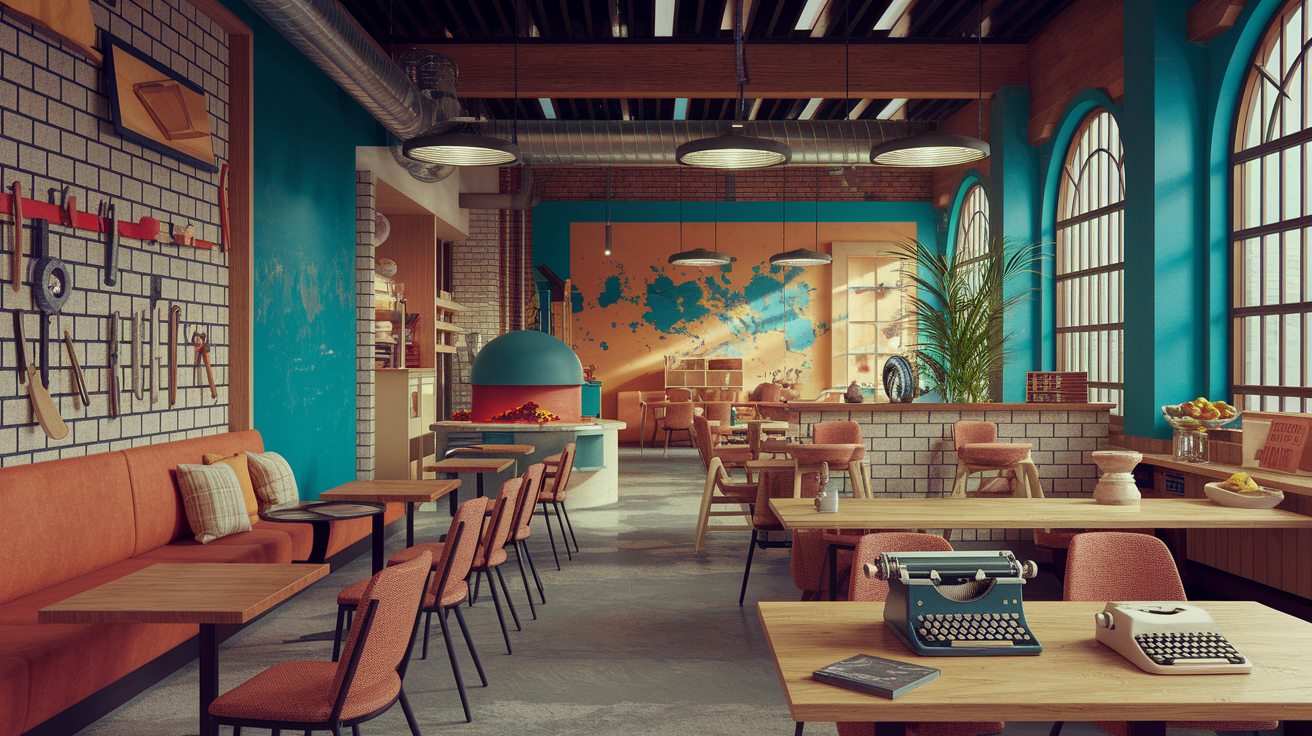
Environment design directly impacts how often and how freely employees engage in creative thinking. Spaces that feel sterile or rigidly organized suppress experimentation. Overly chaotic layouts create cognitive overload. The goal is a middle zone. Structured enough to provide clarity, flexible enough to allow spontaneous reconfiguration when a project demands it.
Cafés demonstrate how sensory prompts and curated objects elicit emotional responses that support focus. A typewriter on a shelf, a reclaimed-wood table, or strategically placed art pieces tell visitors that every detail was chosen for a reason. That intentionality translates into a subconscious permission to care about small things in your own work. Open floor plans, when paired with quiet zones for heads-down tasks, allow employees to shift contexts based on the type of thinking a project requires.
Studio models offer another blueprint. Walk-in access removes friction from starting a creative session. Communal tool walls display materials and instruments so employees can grab what they need without hunting through storage closets. Rotating prompts, like seasonal project themes, keep the environment from becoming stale. Specialized rooms, such as a kiln area for pottery or a splatter studio for high-energy expression, give teams dedicated zones where messiness and experimentation are expected, not discouraged.
Specific creative-space elements that reliably boost output include:
- Communal tool walls stocked with markers, sticky notes, prototyping materials, and quick-reference guides.
- Curated decor that reflects company values and signals attention to detail.
- Quiet zones with acoustic treatment for deep-focus work.
- Prototype corners where unfinished projects remain visible and invite iteration.
- Sensory prompts—music playlists, scent diffusers, adjustable lighting—that let teams shape the atmosphere for different creative tasks.
Programs and Rituals That Reinforce a Creative Culture

Rituals turn creative culture from an abstract idea into daily behavior. They create predictable time blocks when experimentation is expected, normalize documentation of both successes and failures, and give teams a shared vocabulary for talking about innovation. Without rituals, creativity depends on individual initiative and fades when workloads spike.
A weekly café work ritual illustrates how simple structure sustains creative habits. One design team requires members to work from a café one morning per week, documenting the experience with photos and perceptual notes on noise level, energy, and whether productive contacts occurred. The practice breaks desk-bound routines, exposes employees to new environments, and trains them to evaluate how space affects their thinking. Over time, the team builds a vetted list of high-fit locations and shares recommendations across departments.
Rotating seasonal projects, borrowed from studio models, keep creative prompts fresh. Multi-format learning, from self-guided projects to instructor-led workshops, accommodates different learning styles and skill levels. Private events and group challenges add social energy that individual work can’t replicate.
Six creative rituals that strengthen innovation habits include:
- Dedicated tinkering time: 10–20% of weekly hours allocated to side projects, protected from meeting encroachment.
- Weekly café mornings: employees work offsite, documenting sensory and productivity cues.
- Rotating creative prompts: quarterly themes or challenges that reset the innovation agenda.
- Monthly sprint demos: 5-minute presentations where teams show progress on experiments.
- Quarterly show-and-tell: cross-functional gatherings where anyone can share what they tried, learned, or failed at.
- Experiment documentation: brief write-ups with photos, key learnings, and next-step recommendations stored in a shared repository.
Challenges That Can Block Creative Culture (and How to Fix Them)

Even well-designed creative cultures encounter predictable obstacles. Fear of failure shuts down risk-taking when employees see peers punished for unsuccessful experiments. Unsuitable workspaces, too loud or too isolated or poorly equipped, drain energy faster than rituals can replenish it. Leadership distrust manifests when managers demand detailed justifications before approving offsite work or side projects, signaling that autonomy is conditional. Momentum often stalls after pilot programs when no one’s assigned to scale what worked or when innovation budgets get reallocated to operational fires.
Fixes require structural changes, not motivational speeches. Celebrating 2–3 intelligent failures each quarter, publicly recognizing teams who ran rigorous experiments that didn’t produce commercial wins, redefines what success looks like. Vetting creative spaces via short trial visits (a couple of hours) before committing to full workdays reduces wasted time in poorly suited cafés. Allocating ring-fenced innovation budgets, 1–5% of revenue, ensures experimentation doesn’t compete with quarterly targets. Offering psychological-safety training to managers teaches them how to respond to failed experiments in ways that encourage iteration rather than retreat.
Employee perspectives reveal how these fixes land in practice. “I’m trusted to try things that might fail, and that permission led to a product prototype in 6 weeks.” Another noted, “Having a $1K seed fund and 10% of my time unlocked an experiment that improved our workflow by 18%.” A third observed, “Monthly show-and-tell sessions increased cross-team collaboration. We launched a joint feature in 3 months.”
Scaling Creative Culture Through Partnerships and External Influence

Creative culture doesn’t thrive in isolation. It strengthens when organizations actively pull in external perspectives, partner with adjacent industries, and create feedback loops with customers and community spaces. Peer dialogues, online reviews, and curated suppliers broaden the pool of ideas and prevent internal echo chambers from calcifying around familiar solutions.
One team uses peer recommendations to vet cafés before adding them to the approved offsite list, tapping into collective knowledge about which spaces support focus and which create friction. Community interactions, whether at coworking hubs, maker studios, or industry meetups, spark project energy that wouldn’t surface in conference rooms. These environments expose employees to how other disciplines solve problems, cross-pollinating methods and expanding the toolkit available for tackling challenges.
External partnerships and open innovation programs formalize these connections. University collaborations bring academic research into product roadmaps while giving students real-world problem sets to test theories against. Customer feedback loops, structured as co-creation sessions, not one-way surveys, turn end users into innovation partners who shape features before code is written. Sustainability-driven innovation increasingly pulls in environmental scientists, supply-chain experts, and circular-economy advocates, pushing teams to rethink materials, processes, and business models in ways that internal brainstorming alone wouldn’t uncover.
Final Words
Right in the action: we defined what creative culture looks like—psychological safety, curated spaces, rituals, and leadership moves that actually stick.
We walked through real company playbooks (3M, Google, Adobe, Pixar), clear metrics to track, and a 90-day roadmap leaders can use. We also showed café-style rituals you can try next week.
Pick one small experiment, measure it, and iterate. These steps make creative culture real, measurable, and ready to scale. It’s simple to start—and promising to watch unfold.
FAQ
Q: What does creative culture mean?
A: Creative culture means an environment that lets people do their best work, built on psychological safety, autonomy, human-centered problem solving, attention to small quality details, and curated stimuli that spark fresh ideas.
Q: What are the 4 types of crafts?
A: The four common craft types are textile/fiber, wood, ceramics/clay, and metalwork; each focuses on different materials and techniques for making functional or decorative handmade objects.
Q: How to build a creative culture?
A: To build a creative culture, give people psychological safety, autonomy, cross-functional time for experiments, small seed budgets, regular rituals (ideation sprints, show-and-tell), and leaders who model and protect creative time.
Q: How does creative culture impact society?
A: Creative culture impacts society by accelerating new products and services, boosting economic growth and jobs, improving problem solving and community vibrancy, and spreading ideas that change everyday life.