

What if everything you judge about a culture is just the tip of the iceberg?
The culture iceberg model, introduced by Edward T. Hall, says about 10% of culture is visible while 90% hides below the surface.
That hidden mass holds values, beliefs, and assumptions that actually shape how people behave.
When we only notice the tip, we misread intentions, make bad calls at work and school, and spark needless conflict.
This post will show how surface behaviors map to deeper beliefs, and why learning to look beneath the waterline matters.
Comprehensive Understanding of the Culture Iceberg Model

The culture iceberg model says about 10% of culture is stuff you can actually see, while 90% hides below the surface. Edward T. Hall came up with this back in 1976 to explain why people from different backgrounds misread each other so often. Most of us only notice the tip and jump to conclusions without realizing there’s a whole hidden mass underneath. The visible part? Things anyone can clock right away. What people wear, how they say hello, what’s on their plate, how they throw a party. The hidden 90% holds the values, beliefs, and assumptions that actually explain why those surface choices happen in the first place.
Visible culture is easy to catch because your senses do the work. You see traditional outfits at a wedding, hear the language in a classroom, taste the spices in someone’s grandmother’s recipe, smell incense burning during a ceremony, feel the texture of handmade cloth. Take a Sri Lankan New Year celebration. The visible stuff includes lighting a rooster oil lamp on April 14, cooking milk rice for prosperity, switching into traditional clothes for the public events. Outsiders spot all of that first.
Below the waterline sit the things that actually run the show:
- Values that decide what counts most (family loyalty, personal success, keeping the peace in a group)
- Beliefs about right and wrong, fairness, justice
- Assumptions about how the world works and what people “should” do
- Nonverbal rules around eye contact, personal space, when silence is okay
- Etiquette that feels automatic to insiders but stays completely invisible to newcomers
- Emotional expression patterns. When to show anger, joy, grief. How much is too much.
Understanding hidden culture matters because it stops you from misreading people’s intentions in classrooms, offices, anywhere cultures cross. A teacher who only notices a student removing their shoes at the door might miss that it signals deep respect for the learning space and the teacher’s authority. A manager who sees an employee show up late might not realize the team’s late-night meetings clash with cultural expectations around family time. When hidden beliefs stay invisible, surface behaviors get misread, and conflict or bias rushes in to fill the gap.
Expanded Examples of Surface Cultural Expressions

Surface culture pops up everywhere people gather. Offices, schools, public squares, family kitchens. In a Tokyo corporate office, employees might bow slightly when greeting a colleague, wear dark business suits, remove outdoor shoes before entering certain meeting rooms. In a California tech startup, people arrive in sneakers and hoodies, fist-bump instead of shaking hands, eat lunch at their desks while checking Slack. Both places display visible markers of identity and group norms, but the meanings attached to those markers? Totally different.
Four examples from different regions show how wide the range goes:
- Food traditions: sharing a communal dish from one platter in parts of the Middle East versus individual plates and utensils in many Western settings
- Clothing norms: wearing a headscarf as daily practice in some Muslim communities versus optional fashion accessory in secular contexts
- Greeting styles: a cheek kiss in France, a bow in Japan, a firm handshake in the United States, a slight nod in Finland
- Public celebrations: Diwali fireworks and oil lamps in India, Lunar New Year red envelopes in China, Carnival parades in Brazil
Even when surface behaviors look similar, context flips the interpretation. A handshake can signal respect in one country, equality in another, formality or distance in a third. A loud conversation during a meal might mean enthusiasm and connection in one culture, rudeness in another. The same food served at the same table carries different symbolic weight depending on the occasion, who’s present, the unspoken rules about who eats first or how much someone should take.
Real-World Illustrations of Deep Cultural Drivers

Deep cultural norms shape daily decisions in ways people rarely say out loud. In cultures with high respect for authority, employees might wait for explicit permission before speaking up in a meeting, even when they’ve got the solution. In cultures that prioritize individual initiative, silence gets read as disengagement or lack of ideas. The unspoken rule (“speak only when invited” versus “contribute whenever you have something worth saying”) drives behavior, but neither side usually explains it because it feels obvious from the inside.
A middle school teacher in California noticed students from different backgrounds responded to group work in totally different ways. Some jumped in immediately, divided tasks, moved fast. Others hesitated, waited for the teacher to assign roles, checked in constantly for approval before proceeding. The hesitation wasn’t about ability or interest. It reflected deep norms about authority, group harmony, the “right” way to work together. One student explained later that taking charge without being asked felt disrespectful at home, so doing it at school felt weird even when the teacher encouraged it.
In workplaces, deep cultural drivers surface under pressure. During a budget crisis, one team might expect the manager to make a quick unilateral decision to restore stability and show strong leadership. Another team might expect collaborative discussion and shared ownership of the solution, viewing a top-down decision as a sign of distrust. Both groups operate from invisible assumptions about authority, fairness, what “good leadership” looks like. When stress rises, those assumptions come out as frustration, confusion, conflict. “Why won’t they just decide?” versus “Why didn’t they ask us first?”
Comparing Visible and Invisible Layers of the Culture Iceberg
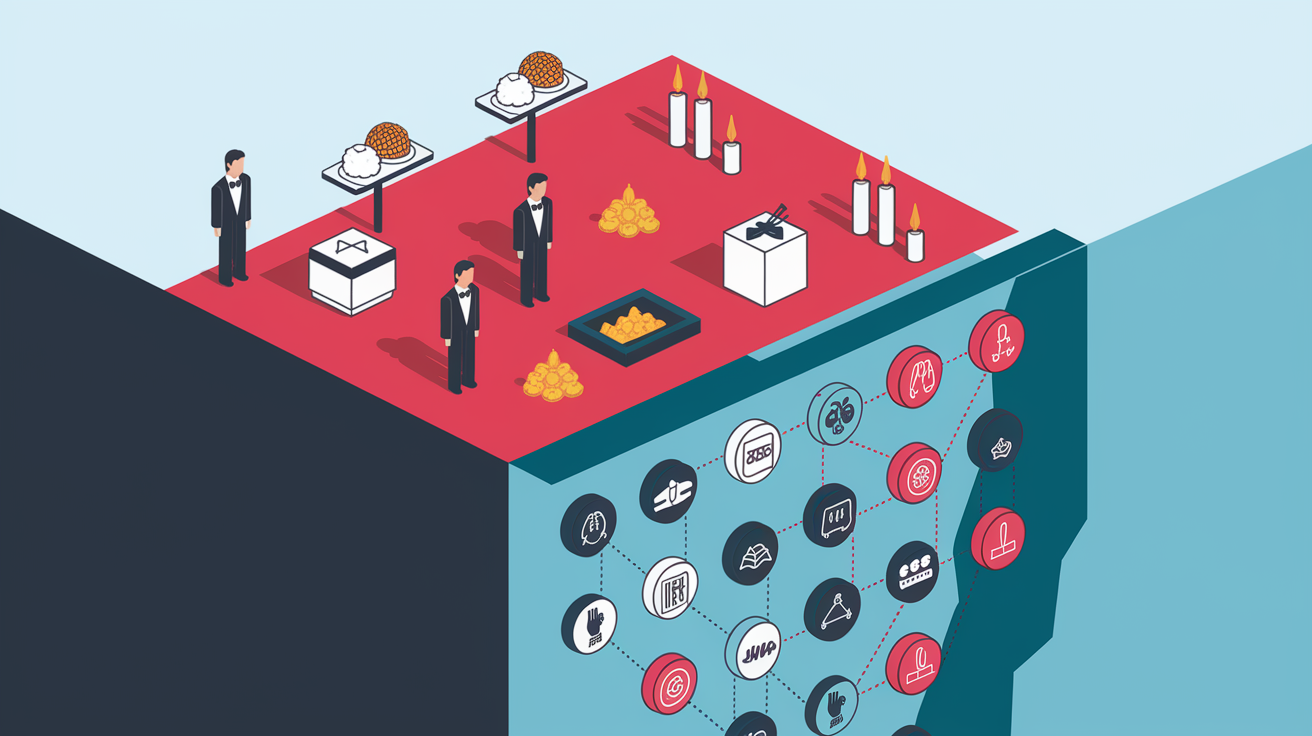
Looking at real contrasts between surface and deep culture helps clarify what sits above and below the waterline. When someone observes a ritual, hears a language, tastes a dish, they’re encountering the accessible layer. When they ask why that ritual matters, what the words imply beyond their dictionary meaning, what the dish symbolizes, they’re beginning to probe the hidden layer. Developing cultural literacy means learning to move back and forth between observation and interpretation without assuming the surface tells the whole story.
| Visible Culture | Invisible Culture |
|---|---|
| Serving rice and curry at a family gathering | Belief that sharing a home-cooked meal expresses care and strengthens family bonds |
| Wearing formal business attire to an interview | Assumption that appearance signals professionalism, respect, seriousness about the opportunity |
| Bowing when meeting an elder | Deep norm that age and experience deserve visible respect and deference |
| Lighting candles during a religious ceremony | Underlying belief in the symbolic power of light to represent hope, memory, divine presence |
The Role of the Culture Iceberg in Cross-Cultural Communication

Miscommunication happens when people interpret behavior using only their own cultural reference points. Someone raised in a culture where direct eye contact signals honesty and confidence might distrust a colleague who looks down during a conversation, not realizing that in the colleague’s culture, sustained eye contact with a superior is considered confrontational or disrespectful. The visible behavior (where someone looks) gets read through invisible rules about power, respect, social hierarchy. Without awareness of the submerged layer, the interpretation feels obvious but is often completely wrong.
Common barriers that pop up when hidden culture stays unexamined:
- Silence interpreted as agreement in one culture and as disagreement or discomfort in another
- Indirect phrasing read as evasiveness rather than a polite way to soften bad news or criticism
- Time expectations that treat “on time” as exactly at the scheduled minute versus within a flexible window
- Personal questions about family or marital status seen as friendly interest in one setting, intrusive in another
- Emotional restraint mistaken for coldness or lack of engagement when it actually signals professionalism or self-control
Building cultural intelligence (CQ) starts with recognizing that surface behaviors are just signals, not the full message. High-CQ individuals pause before judging, ask clarifying questions, look for patterns rather than jumping to conclusions based on one interaction. They treat mismatches as chances to learn about hidden norms instead of proof that someone’s rude, lazy, or difficult.
Educational Uses of the Culture Iceberg Model

Teachers use the iceberg model to help students understand their own cultural identities and build empathy for classmates whose backgrounds differ. Reflection questions open the conversation. What does culture mean to you? How do your family’s values show up in your daily choices? What do you assume everyone does the same way you do? These prompts move students from surface observations to deeper self-awareness and curiosity about others.
A second-grade teacher introduced the model during a unit on cultural celebrations by asking students to create digital iceberg graphics using Google Slides. Each child labeled the visible part with things like favorite foods, clothing for special occasions, languages spoken at home, family traditions anyone could see. Below the waterline, they added values their families talked about. Respect for elders, importance of education, sharing with neighbors, honoring ancestors. The class compared slides and discovered overlapping values even when the visible traditions looked completely different.
The project gave students language to talk about identity beyond stereotypes. Instead of reducing culture to “where your family is from” or “what you eat,” students saw culture as a whole system that includes what you believe, how you show respect, what you prioritize, how you make sense of the world. Publishing the iceberg graphics on the class website let families see how their children understood and valued their own heritage. It started conversations at home about cultural transmission across generations.
A simple four-step activity for any classroom:
- Observe and list visible culture. Have students spend a week noticing and recording surface cultural markers at home, in school, in their community (food, dress, language, music, celebrations, greetings).
- Interview for hidden culture. Students ask a family member or elder to explain the “why” behind one visible tradition. What does this ritual mean? Why do we do it this way? What value does it represent?
- Create an iceberg diagram. On paper or digitally, students draw an iceberg and place visible items above the waterline and hidden values, beliefs, norms below.
- Share and reflect. In small groups, students present their icebergs, identify commonalities and differences, discuss what surprised them about their own culture or others’.
Organizational Applications of the Culture Iceberg

In workplaces, deep culture shapes everything from how people respond to feedback to how they interpret deadlines, but those norms rarely appear in the employee handbook. A new hire might read the company’s stated value of “open communication” and assume it means speaking up in meetings, sending direct emails, challenging ideas publicly. If the actual workplace norm is to share concerns privately with a manager first and avoid public disagreement, the new hire’s behavior will be read as aggressive or disrespectful even though they’re following the stated value. The invisible rule (how to communicate, not just that communication is valued) drives the real culture.
One HR team investigated why a department had chronic lateness issues despite repeated warnings. Exit interviews and anonymous surveys revealed that the manager scheduled check-ins at 8 p.m. to accommodate global time zones, and employees were often still awake past midnight preparing updates. The next morning’s 9 a.m. start time felt impossible after late-night work, but no one had said it out loud because the assumption was that professional employees should manage their own schedules. When the team moved international calls to earlier in the day and set a hard stop for evening work, punctuality improved within two weeks. The surface problem (lateness) was actually a symptom of a hidden structural norm that conflicted with expectations.
Linking iceberg awareness to diversity, equity, inclusion, and belonging (DEIB) means recognizing that fairness isn’t just about treating everyone the same. It’s about understanding that people bring different deep-culture expectations about authority, time, communication, respect. A manager trained in iceberg thinking asks not just “Did this employee follow the rule?” but “Does this employee understand the unspoken norm behind the rule, and does the rule itself reflect only one cultural perspective?” Conflict resolution improves when leaders surface hidden assumptions, name them clearly, create space for multiple norms to coexist or for new shared norms to develop.
Practical Tools for Exploring the Culture Iceberg
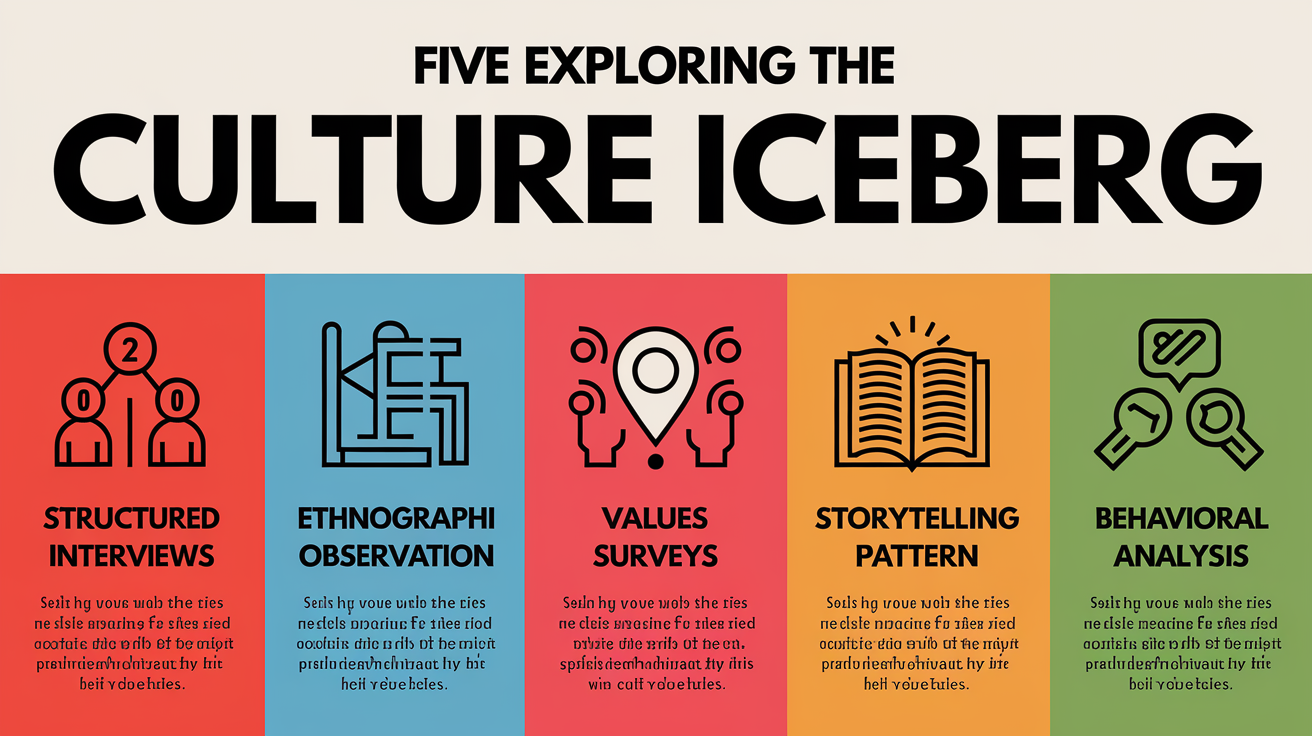
Uncovering hidden culture requires deliberate methods because people rarely volunteer their deepest assumptions in casual conversation. Structured tools make the invisible visible and help teams, classrooms, and communities build shared understanding.
Five effective methods:
- Structured interviews. Ask open-ended questions like “Describe a time you felt respected at work” or “What does a successful team look like to you?” and listen for underlying values in the answers.
- Ethnographic observation. Spend time watching how people interact in natural settings, noting repeated behaviors, unspoken rules, moments of tension or ease.
- Values surveys. Use questionnaires that ask people to rank priorities (individual achievement vs. group success, stability vs. innovation, hierarchy vs. equality) and compare results across groups.
- Storytelling exercises. Invite participants to share a meaningful cultural memory or family tradition, then discuss what values or beliefs the story reveals.
- Behavioral pattern analysis. Track data like meeting participation, email response times, decision-making speed and look for patterns that hint at hidden norms.
Quick Diagnostic Flowchart
Start by observing repeated behaviors or points of friction. Late arrivals, low participation, high turnover, resistance to a new policy. Next, inquire by asking clarifying questions, conducting interviews, running focus groups to understand why the behavior happens and what people believe is “normal” or “right.” Finally, interpret patterns by comparing visible actions to stated values, identifying mismatches, surfacing the hidden assumptions that drive the gap.
How Deep Cultural Values Change Over Time

Deep values resist change because they’re learned early, reinforced constantly, tied to identity and belonging. A person raised to prioritize family obligations over individual ambition won’t flip that priority after a single diversity training session or a new company policy. Shifting core values requires sustained experience, new social norms, often a generational timeline as younger members grow up with different influences and pass those influences forward.
Three primary drivers of long-term cultural change:
- Lived experience and exposure. Sustained contact with different norms through travel, immigration, intermarriage, diverse workplaces gradually shifts what feels “normal.”
- Institutional reinforcement. Changes in law, education curriculum, media representation, organizational policy signal new expectations and reward new behaviors.
- Leadership modeling. When authority figures visibly practice and reward new values, others begin to see those values as legitimate and desirable.
Aligning visible changes with core values prevents surface fixes from failing. A company that introduces flexible work hours (visible change) without addressing the underlying belief that “serious employees are always available” will see the policy ignored or resented. Real transformation happens when leaders articulate the new belief (“We value results and well-being, not hours logged”), model it consistently, update incentives and promotion criteria to reflect it, give the culture time to internalize the shift. Surface and depth must move together, and patience isn’t optional.
Final Words
We walked through the culture iceberg, diving into visible stuff like food, dress, and rituals, and into deeper layers people don’t see: values, assumptions, and emotional rules.
You saw classroom and workplace examples, simple tools to map hidden norms, and why reading only the surface leads to confusion.
Use the culture iceberg as a quick lens: spot what’s obvious, ask about what’s beneath, and you’ll communicate better across groups. That’s practical, and it actually works.
FAQ
Q: What is the main point of the culture-iceberg analogy?
A: The main point of the culture-iceberg analogy is that most cultural elements are hidden beneath the surface—about 10% visible artifacts and 90% unseen values, beliefs, and assumptions shaping behavior.
Q: What are the three levels of culture iceberg?
A: The three levels of the culture iceberg are surface artifacts (visible behavior), norms and espoused values (partly visible), and underlying assumptions and beliefs (deep, largely invisible).
Q: Who came up with the cultural iceberg?
A: Edward T. Hall popularized the cultural iceberg metaphor in the 1970s, linking visible culture to a much larger set of hidden values and assumptions that shape everyday behavior.
Q: What is Edward T. Hall’s cultural Iceberg Model 1976?
A: Edward T. Hall’s cultural Iceberg Model (1976) describes culture as mostly hidden—roughly 10% observable symbols and rituals and 90% deeper values, norms, and unconscious assumptions guiding interaction.