

Mass culture isn’t what we freely pick — it’s what media and commerce push to the widest crowd.
Open Netflix, scroll Billboard, or walk into H&M and you’ll see the same formulas everywhere.
Shows, songs, and styles are engineered to win big audiences and sell more.
This post argues media companies and retail giants don’t just distribute culture — they manufacture taste, standardize art, and turn identity into a product using algorithms, marketing, and factory production.
That matters because it steers what millions like, buy, and talk about right now.
We’ll unpack how that machine works and what to watch next.
Core Definition and Foundations of Mass Culture Today

Pull up Netflix, check the Billboard charts, or walk through any H&M, and you’re swimming in mass culture. The shows millions binge at once. Songs built to go viral. Clothes replicated from Seoul to São Paulo. They all follow the same playbook: standardized, formulaic, mass-produced to entertain huge audiences and make money. Mass culture is this whole system of cultural stuff designed to reach as many people as possible by appealing to what critics call the “lowest common denominator.” The big thinkers who mapped this out include Dwight Macdonald, whose 1957 book The Responsibility of Peoples, And Other Essays in Political Criticism laid it all out, and Frankfurt School theorists like Theodor Adorno, who argued that factory-scale cultural production basically manipulates and sedates us.
These ideas came together in the early-to-mid 1900s when mass media suddenly could reach millions at once. Walter Benjamin’s 1936 essay “The Work of Art in the Age of Mechanical Reproduction” looked at how copying technologies changed cultural experience. Then the Frankfurt School coined “culture industry” in their 1944 work “Dialectic of Enlightenment,” framing popular entertainment as economic and ideological control dressed up as fun.
Mass media’s explosion let mass culture grow like nothing before. In the U.S., TV ownership jumped from about 9 percent of households in 1950 to roughly 90 percent by 1960. One decade, tenfold increase. That completely rewired how culture moved. Broadcast networks, mass-market magazines, commercial radio, and later digital platforms created pipelines that could blast identical content to millions of totally different people, turning culture into something synchronized and market-driven.
What defines mass culture conceptually:
Standardization – recycled genres, predictable plots, safe aesthetics that cut creative risk and boost market appeal
Mass appeal – built to grab the widest possible crowd by dodging anything too niche or challenging
Commercial orientation – profit shapes every decision, box office and ad revenue become the scorecard
Media dependence – needs industrial distribution (broadcast, streaming, retail chains) to actually reach people
Broad accessibility – low barriers through cheap prices, simple stories, familiar references
Key Characteristics and Mechanisms Driving Mass Culture Production

Every blockbuster and chart-topper comes from an industrial machine treating culture like any other product. Mass cultural stuff isn’t made by solo artists locked in studios. It’s assembled by teams of technicians, marketers, and executives working for commercial studios and media giants operating on strict profit logic. Macdonald put it bluntly: mass culture gets created by technicians for companies, gutting the individual genius thing we associate with real art. The Frankfurt School hammered home how this industrial setup generates standardization. Production-line repetition of proven formulas that cut uncertainty and guarantee predictable returns. One successful rom-com spawns fifty knockoffs. A viral pop hook gets remixed endlessly. A trending fashion cut shows up in every mall.
Standardization runs on formula repetition. Narrative structures, musical progressions, visual aesthetics get turned into templates you can crank out efficiently. Cultural commodification transforms experiences and identities into products you can sell: a lifestyle becomes a subscription box, a subculture becomes a target demographic, a moment of real connection becomes a curated Instagram feed. Profit drives every creative choice. Test audiences screen rough cuts, focus groups rate which character they like, algorithms predict which hook will maximize streaming time. This explains why mass culture feels so repetitive. Innovation’s risky. Proven formulas deliver reliable audience capture and advertising dollars.
| Mechanism | How It Works | Cultural Impact |
|---|---|---|
| Industrial Production | Centralized studios and labels hire specialized workers to manufacture cultural goods at scale using division of labor and standardized workflows | Swaps individual artistry for team-assembled products, prioritizes efficiency and reproducibility over originality |
| Standardization & Formula | Proven story structures, genre conventions, aesthetic templates get recycled to cut financial risk and maximize audience recognition | Creates predictable, familiar experiences that can feel repetitive, limits creative experimentation for market-tested patterns |
| Commodification | Cultural experiences, identities, communities get packaged as purchasable goods and services designed to generate revenue | Converts culture into transactions, aligns creative output with profit incentives rather than artistic or community values |
Distinguishing Mass Culture from Folk Culture and High Culture
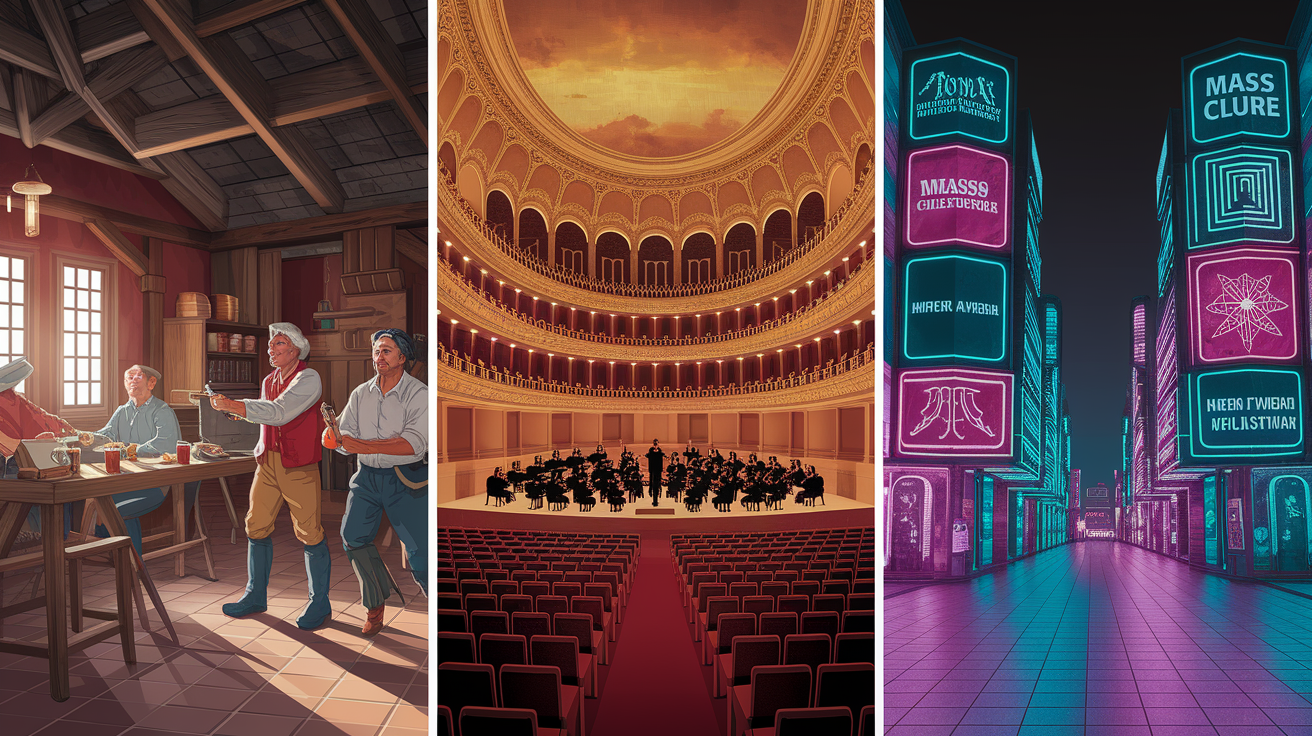
Folk culture grows from communities themselves, passed down through generations and tied to specific places, traditions, shared practices. A folk song at local gatherings. A regional craft technique taught hand to hand. A storytelling tradition evolving over centuries within a particular culture. These forms are community-created, authentic, pre-industrial. Folk culture doesn’t need mass media or commercial distribution. It lives in everyday practices of ordinary people and reflects their actual experiences without middlemen.
High culture sits at the opposite end. Elite, institutionally blessed, tied to individual genius. Beethoven’s symphonies, Rembrandt’s paintings, avant-garde theater, experimental literature. Works valued for intrinsic artistic merit, appreciated by educated audiences, often supported by non-commercial institutions like museums and universities. High culture demands specialized knowledge, operates outside market pressures, emphasizes innovation, complexity, lasting aesthetic achievement.
Mass culture’s different entirely. Produced by commercial entities, distributed through industrial channels, designed to hit populist tastes rather than elite sensibilities or community traditions. Macdonald called it “kitsch.” Superficial, market-driven pseudo-culture lacking folk art’s authenticity or high culture’s artistic integrity. Where folk culture grows organically from below and high culture gets created by exceptional individuals, mass culture gets manufactured from above by corporations chasing the widest possible audience.
The contrasts become obvious looking at specific traits:
Production method – Folk (community collaboration), High (individual genius), Mass (corporate teams and technicians)
Audience scale – Folk (local communities), High (small educated elite), Mass (millions of different consumers)
Commercialization level – Folk (non-commercial exchange), High (institutional or patron support), Mass (profit-driven production)
Artistic intent – Folk (cultural continuity and identity), High (aesthetic innovation and lasting value), Mass (entertainment and market appeal)
Criticisms and Social Concerns Associated with Mass Culture
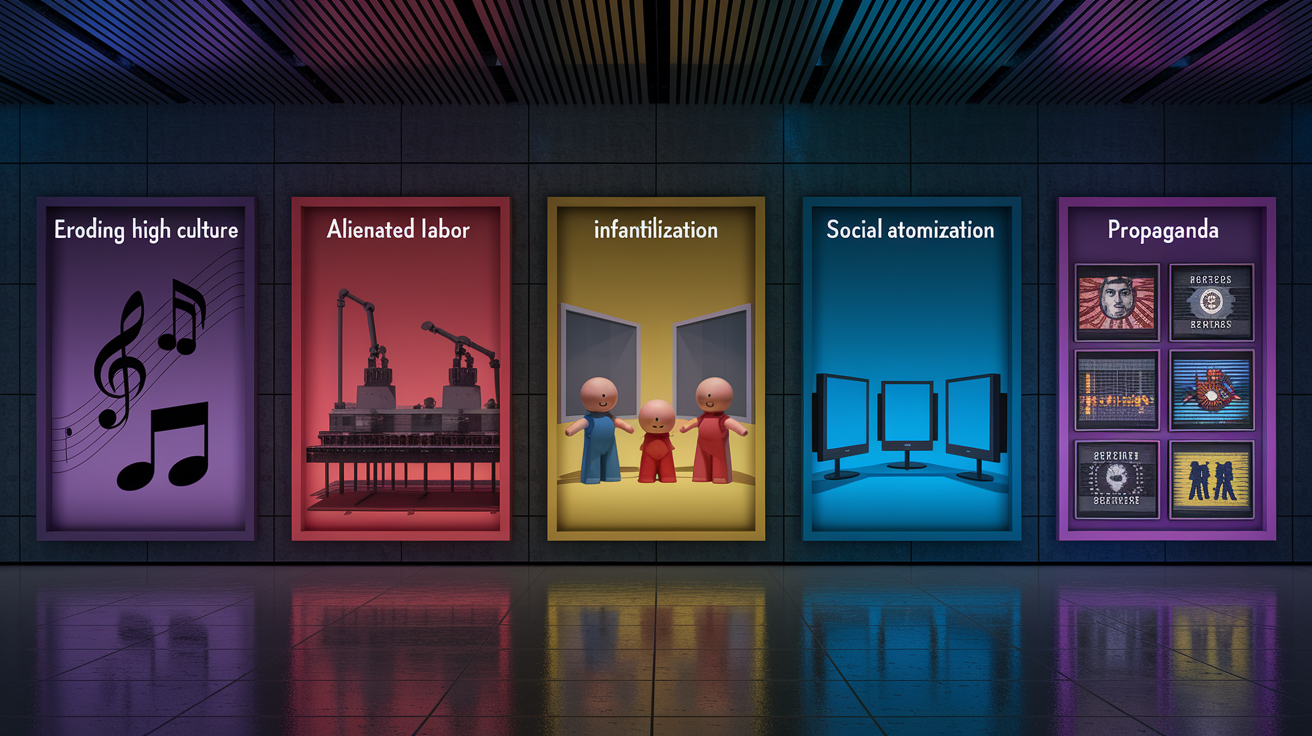
Macdonald identified five major harms from mass culture’s dominance. First, the sheer volume of mass-produced entertainment threatens to erode high culture. Theater plays get axed or adapted for movie rights, classical music gets pushed to niche audiences as pop soundtracks dominate, serious literature competes for shelf space with formulaic bestsellers. Second, creative work becomes alienated labor. Independent artists get replaced by production-line workers executing corporate formulas, stripping meaning and autonomy from cultural creation. Third, mass culture infantilizes adults while exposing children to inappropriate content. Macdonald noted that 1950s American adults consumed children’s programming like The Lone Ranger, while children gained access to adult-oriented products, flattening cultural distinctions.
Fourth, mass culture erodes the social fabric by swapping community engagement for isolated, passive consumption. Audiences sit alone watching screens instead of gathering in shared public spaces. Cultural participation shrinks to clicking “buy” or scrolling past. This atomization makes populations easier to manipulate politically because shared critical discourse and communal resistance weaken. Fifth, mass culture aids totalitarian control. Macdonald pointed to how Nazi Germany and the USSR weaponized mass entertainment to pacify and propagandize citizens, turning culture into a political domination tool.
The Frankfurt School reinforced these worries by arguing that standardization produces passive, uncritical audiences. When every song follows the same structure, every show the same narrative arc, every ad the same emotional triggers, people lose capacity for independent thought and aesthetic judgment. Cultural products become interchangeable. Audiences get conditioned to accept whatever the industry serves up. Modern critics extend this framework to contemporary concerns. Global cultural homogenization flattens regional diversity into a single Americanized aesthetic, commodification reduces every experience to a purchasable transaction, corporate consolidation concentrates cultural power in fewer hands.
Contemporary examples show these critiques in action. Reality TV shows like I’m a Celebrity exemplify formulaic entertainment designed for broad appeal and advertising revenue, not artistic merit or meaningful engagement. Streaming platforms release algorithmically optimized content hitting predictable emotional beats. Fast fashion cycles churn out trend-driven clothing at breakneck speed, training consumers to treat garments as disposable. Each instance reflects mass culture’s core logic: maximize reach, minimize risk, convert attention into profit.
Political and Social Risks
Mass culture’s capacity for political manipulation extends beyond historical examples. When cultural consumption becomes standardized and passive, populations grow susceptible to propaganda embedded in entertainment. Nazi Germany used mass rallies, films, radio broadcasts to manufacture consent and demonize enemies. The USSR employed mass culture to glorify the state and suppress dissent. Today, subtler forms persist. Algorithmic feeds create filter bubbles reinforcing existing beliefs, commercial media frames political discourse within narrow boundaries acceptable to advertisers, spectacle-driven coverage displaces substantive public debate. The erosion of a robust public sphere where citizens engage critically with diverse ideas leaves democracies vulnerable to manipulation through emotionally charged, formulaic messaging designed to pacify rather than inform.
Contemporary Expressions of Mass Culture in Digital and Global Media
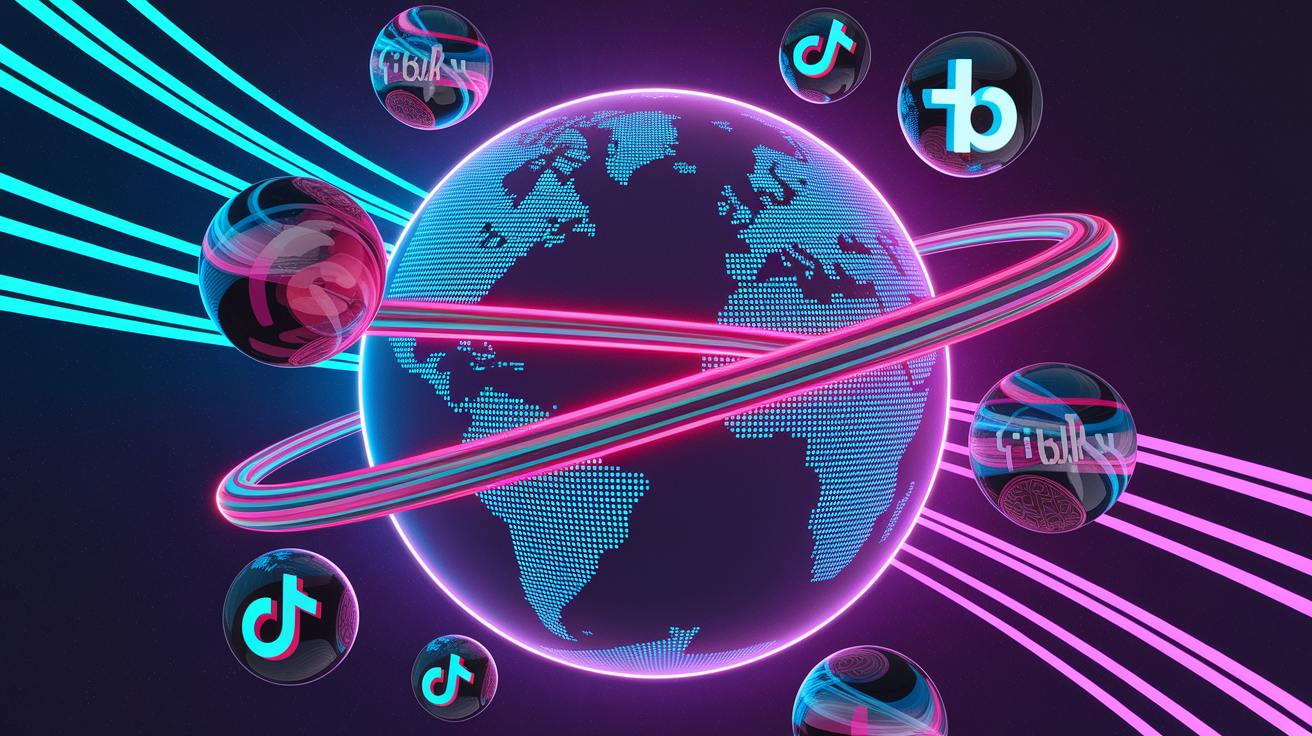
Post-1945, American cultural exports (Hollywood films, pop music, TV formats, consumer brands) expanded globally, contributing to what critics call “Americanisation.” U.S. studios and record labels dominated international markets, spreading standardized aesthetics, narrative formulas, consumption patterns across continents. Global audiences watched the same blockbusters, listened to the same chart hits, adopted similar fashion trends, creating cultural convergence unprecedented in history. This flow wasn’t purely one direction. Local industries adapted American formats, some regional productions achieved global reach. But the scale and power of U.S. cultural industries shaped mass culture’s global architecture.
Digital platforms and algorithmic curation have intensified mass culture’s reach and speed. Streaming services like Netflix and Spotify use recommendation algorithms to predict and shape user preferences, creating feedback loops that amplify popular content and marginalize niche work. Social media platforms circulate viral trends, memes, challenges that spread globally within hours, turning cultural moments into synchronized events experienced by millions simultaneously. TikTok dances, Instagram aesthetics, Twitter discourse cycles exemplify how digital infrastructure accelerates mass culture’s standardization. Users remix the same templates, follow the same trends, consume content curated by attention-maximizing algorithms.
Yet contemporary mass culture also shows signs of hybridization and participatory dynamics challenging older critiques. Local cultures adapt and remix global formats, creating hybrid forms blending American influences with regional traditions. K-pop combines Western pop production with Korean performance styles, Bollywood integrates Hollywood techniques with Indian storytelling, Latin trap fuses hip-hop beats with Spanish-language lyrics. Audiences don’t just passively consume. They create fan art, remix tracks, build online communities, engage critically with media texts. This participatory culture suggests mass culture’s impact is more complex than simple top-down manipulation.
Five modern examples of mass culture in action:
Streaming platform hits – Shows like Squid Game or Stranger Things reaching tens of millions of viewers globally within days of release, demonstrating mass media’s synchronized reach
Viral memes and challenges – TikTok trends spreading across continents, with millions replicating the same dance, sound clip, visual template
Global pop music formulas – Chart-topping hits engineered for maximum streaming retention, featuring predictable structures, catchy hooks, cross-cultural appeal
Fast fashion cycles – Brands like Zara or Shein churning out trend-driven collections weekly, training consumers to treat clothing as disposable and trend-responsive
Social media spectacles – Influencer campaigns, product drops, celebrity moments generating coordinated attention spikes and commodified engagement
Audience Agency, Participation, and Subculture Dynamics Within Mass Culture
Audiences aren’t the passive, uniform mass that early critics imagined. Studies of media reception show people engage selectively, interpret content through personal and cultural lenses, often resist or reinterpret intended messages. Fans create elaborate online communities, produce unauthorized content, critique media texts with sophisticated analytical tools. Participatory culture (where users generate, share, remix media) challenges the assumption that mass culture simply flows one way from producers to consumers. When fans write fanfiction, remix songs, create memes that subvert commercial messages, they demonstrate active engagement rather than pacified consumption.
Subcultures continually emerge within and alongside mass culture, carving out spaces for alternative identities and aesthetics even as mainstream industries attempt to co-opt and commodify them. Punk, hip-hop, goth, rave culture, countless other movements started as grassroots resistance to dominant cultural norms, though many eventually got absorbed into commercial markets. This cycle (subcultural innovation followed by mainstream absorption) suggests mass culture is more dynamic and contested than a simple top-down model implies. Subcultures adapt, splinter, evolve, preserving pockets of diversity and resistance even within heavily commercialized cultural landscapes.
| Subculture | Interaction with Mass Culture |
|---|---|
| Fan communities (e.g., Marvel fandom, K-pop stans) | Engage deeply with mass-produced franchises but create unauthorized content, critique canon, build autonomous social spaces that exceed corporate control |
| DIY and indie music scenes | Resist commercial production norms by self-releasing music, organizing independent venues, prioritizing artistic integrity over market success, often get co-opted when successful |
| Online subcultures (e.g., meme communities, niche hobbyists) | Operate within mass platforms (Reddit, Discord, TikTok) but develop specialized languages, inside jokes, values that distinguish them from mainstream users, blend participation with critique |
The Future of Mass Culture: Globalization, Technology, and Cultural Change

Globalization continues reshaping mass culture by enabling cross-cultural exchange at unprecedented scale and speed. Cultural formats now circulate globally in real time. A Korean drama can trend worldwide, a Latin American song can top charts across continents, fashion trends can spread from Tokyo to New York overnight. This intensified flow creates both homogenization pressures (global brands and aesthetics converging) and hybridization opportunities (local adaptations and fusion forms). The tension between these forces will define mass culture’s future. Whether global connectivity leads to a flattened monoculture or a more diverse, interconnected cultural ecosystem remains contested.
Technological innovations are transforming how mass culture gets produced, distributed, consumed. Immersive entertainment (virtual reality experiences, augmented reality filters, interactive streaming content) promises deeper engagement but also more sophisticated mechanisms for capturing attention and extracting data. Cultural analytics and algorithmic curation will grow more precise, predicting and shaping consumer preferences with machine-learning models trained on billions of data points. Experiential marketing blurs the line between entertainment and advertising, turning brand interactions into curated cultural moments. These developments raise concerns about homogenized aesthetics optimized for algorithmic performance and attention-economy pressures that prioritize engagement metrics over artistic or social value.
Consumer identity and behavior are evolving within this global, technologically mediated mass culture. Younger generations navigate multiple cultural identities simultaneously, consuming Korean pop, American streaming series, local traditions in fluid combinations. Digital literacy enables some consumers to engage critically, fact-check media narratives, participate in cultural production, while others remain vulnerable to manipulation through algorithmically curated filter bubbles. The future will likely see ongoing tension between democratic access (mass culture reaches billions) and commercial control (concentrated corporate power shapes what circulates).
Four major trends anticipated to shape mass culture’s trajectory:
Platform consolidation and algorithmic governance – A small number of tech giants (streaming services, social platforms) will control cultural distribution, using AI-driven curation to determine what billions see
Hybrid global-local formats – Continued blending of global mass culture with regional traditions, creating diverse fusion forms that complicate simple homogenization narratives
Participatory and user-generated content – Growing role of audiences as co-creators, with platforms enabling remix culture, fan production, decentralized cultural creation alongside corporate content
Immersive and data-driven experiences – Shift toward interactive, personalized entertainment using biometric data and behavioral analytics to tailor content in real time, intensifying engagement but raising privacy and manipulation concerns
Final Words
TV, pop music, and fast fashion show mass culture in action. We defined it as standardized, broad-reaching products, named theorists like Macdonald and the Frankfurt School, and showed how mass media scaled it.
We also covered production logic, compared mass, folk, and high culture, and listed critiques such as homogenization and passivity. Then we mapped digital twists, like algorithms, memes, streaming, and growing audience participation.
Mass culture isn’t just a set of problems. It’s a living, changeable scene where fans remix, resist, and reshape what’s mainstream. Expect more hybrid, participatory moments and creative surprises ahead.
FAQ
Q: What is the meaning of mass culture?
A: The meaning of mass culture is cultural products such as TV shows, pop music and fast fashion that are standardized, aimed at wide audiences, and produced for profit. Critics like Macdonald and Adorno warned of its effects.
Q: What is an example of mass culture?
A: An example of mass culture is reality TV and blockbuster movies, alongside chart pop music and fast fashion brands—all made to appeal to large audiences and generate commercial profit.
Q: What are the 4 types of culture?
A: The four types of culture are high culture, folk culture, popular (mass) culture, and subcultures or countercultures—each differs by who creates it, audience size, commercial intent, and social status.
Q: What is the ideology of mass culture?
A: The ideology of mass culture is that culture should be widely accessible, standardized, and commercially oriented, favoring consumer values and easy entertainment—often criticized for promoting sameness and passive consumption.