

Can a pot or a phone tell us who mattered in a society?
Material culture studies the stuff people make, use, and leave behind to read social rules, values, and power.
From stone tools to smartphones, objects record daily habits, status, trade links, gender roles, and belief systems, and often speak louder than texts.
This piece shows how archaeologists and anthropologists read objects at three scales: single items, assemblages, and landscapes, to rebuild how people lived and what they cared about.
Expect clear examples, key methods, and why objects still shape how we see ourselves.
Defining the Foundations of Material Culture
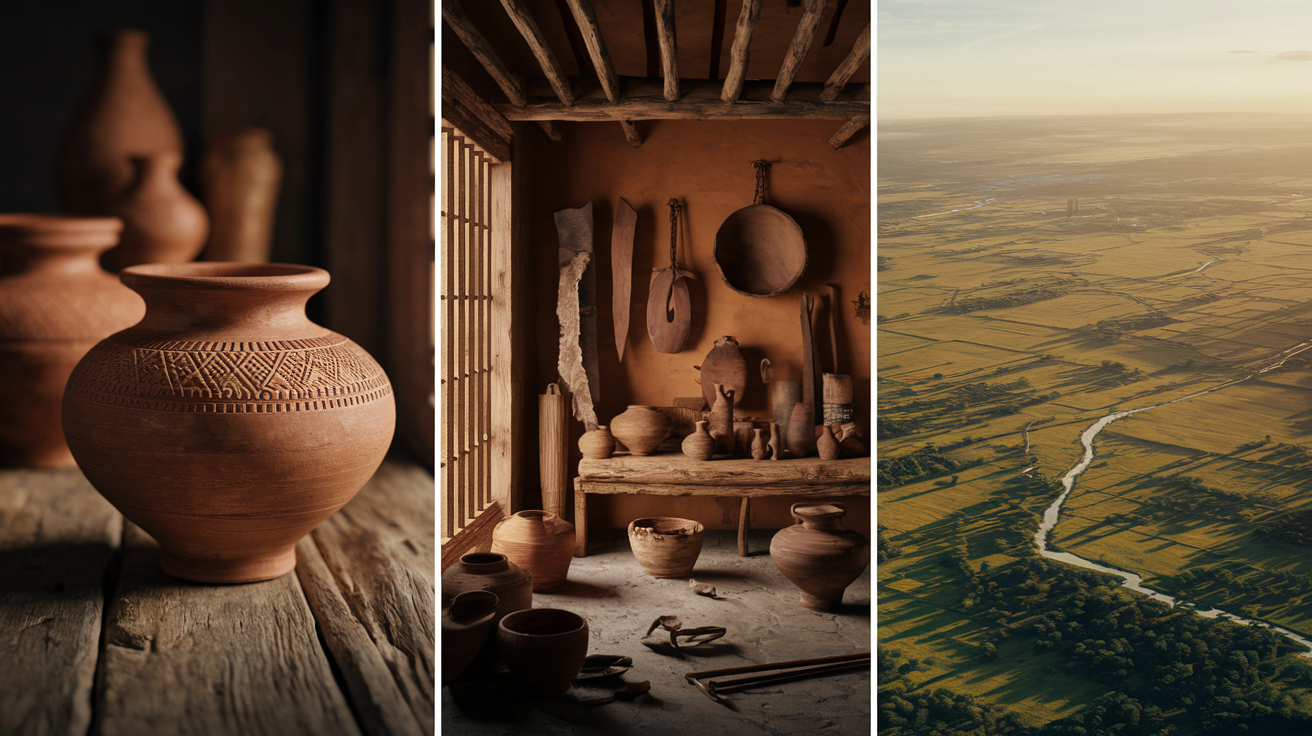
Material culture is how researchers study the physical stuff humans make, use, and leave behind to figure out what mattered to different societies. We’re talking about everything from stone tools chipped 2.6 million years ago to the phone in your pocket right now. Scholars look at three levels: individual objects (like one clay pot or bronze ax), groups of artifacts found together (a household’s possessions or what got buried in a grave), and entire landscapes (how settlements spread across regions and how trade routes connected them).
This is different from non-material culture, the intangible things like beliefs, language, or social rules. Material culture gives you the physical proof. A cooking pot isn’t just for making dinner. It tells you about food traditions, how households worked, and maybe trade networks if the clay came from somewhere else. Anthropologists and archaeologists love material culture because it’s concrete evidence, especially when written records don’t exist or only tell part of the story.
Objects don’t just sit there passively illustrating life. They do things. They show off status, reinforce who does what based on gender, make religious rituals possible, mark boundaries.
Common types of objects studied:
- Tools and implements (stone blades, farm equipment, digital devices)
- Buildings (temples, houses, city infrastructure)
- Clothing and textiles (woven garments, dyed fabrics, shoes)
- Visual and decorative arts (paintings, pottery decoration, jewelry)
- Everyday household items (furniture, dishes, toys, books)
Key Categories of Material Culture Objects and Their Cultural Roles
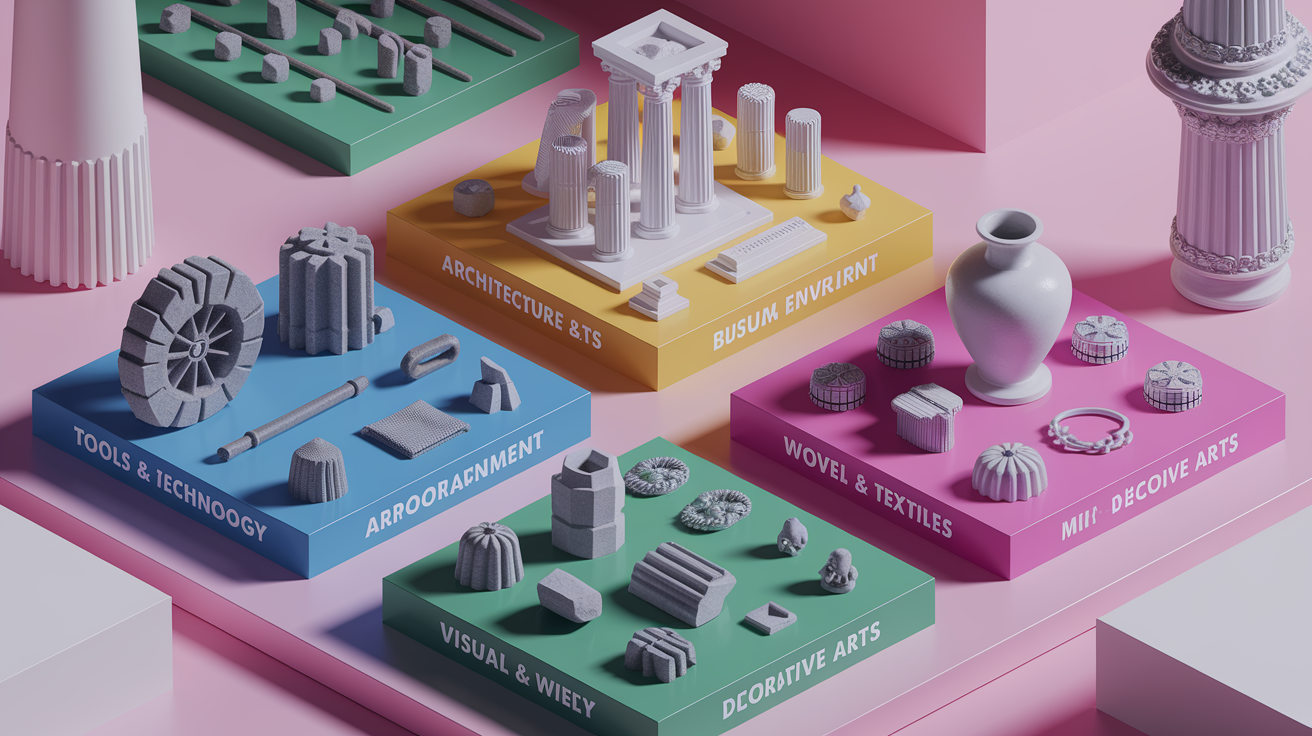
Researchers usually sort material culture into four main buckets, each revealing different things about how societies operate. Tools and technology are the oldest category—simple stone choppers show up around 2.6 million years ago and the category runs all the way through metal tools, factory machines, and modern electronics. These objects reveal technical know-how and economic setup, who did which jobs, and who controlled resources. Buildings and the built environment range from basic shelters to massive temples and public works. A Roman amphitheater or a Victorian row house tells you who held power, how space got divided up, and what activities people valued most.
Clothing and textiles are goldmines for interpretation even though fabric rarely survives well. Woven materials, dyeing methods, and garment styles communicate gender, age, job, and social rank. They also document trade (imported dyes or fibers) and tech capabilities (what kind of looms, how complex the weaving). Visual and decorative arts like paintings, sculpture, fancy ceramics, and personal jewelry encode symbolic meaning, religious ideas, aesthetic values, and political messages. A painted Greek vase from around 500 BCE might show mythological scenes that reinforced cultural narratives, while 20th-century branded electronics signal participation in global capitalism and how people construct identity.
Six core categories and what they tell us:
- Tools – How things got made, survival strategies, tech spreading between groups
- Architecture – Settlement patterns, public versus private space, monuments that broadcast power
- Clothing – Gender norms, status display, adapting to climate, trade connections
- Decorative arts – Religious symbolism, aesthetic standards, specialized craftspeople
- Household goods – Daily routines, family structure, consumption habits
- Consumer products – Economic systems, identity building, globalization effects
Material Culture in Anthropology and Archaeology

In anthropology and archaeology, material culture is the main evidence for reconstructing societies that left no written records or whose texts barely survived. Archaeologists dig up and analyze artifacts to figure out socioeconomic organization—who made what, who consumed which goods, how resources moved through communities. A Bronze Age burial from around 2000 BCE containing imported amber beads, locally made pottery, and a copper dagger suggests trade networks, specialized crafts, social ranking, and possibly gender-specific burial customs. By examining entire assemblages (the collection of items found together in a trash pit, house floor, or ritual deposit), researchers detect patterns in daily life, seasonal activities, and how belief systems shifted over time.
Context and stratigraphy are the backbone here. An artifact’s meaning changes wildly depending on where it turned up. A cooking pot discovered in a hearth area means everyday food prep. That same pot in a tomb becomes a ritual offering for the dead. Stratigraphy (studying soil layers and their sequence) lets archaeologists establish timelines and understand how sites built up over decades or thousands of years. This layered context connects objects to specific moments and specific human actions—planting crops, throwing a feast, abandoning a settlement, conducting a burial.
Material culture also opens windows into belief systems and worldviews that otherwise vanish without a trace. Symbolic objects like figurines, ritual vessels, or buildings oriented to the winter solstice provide clues about religious practice, mythological stories, and the social roles of priests or shamans. By combining material remains with ethnographic comparisons, historical texts when available, and experimental attempts to replicate ancient techniques, anthropologists reconstruct how people understood their world and their place in it.
| Analytical Scale | Research Focus |
|---|---|
| Object-level | Individual artifact attributes, manufacturing technique, use-wear, symbolic decoration |
| Assemblage-level | Groups of artifacts from a single context (household, workshop, grave); patterns in consumption, deposition, and discard |
| Landscape/settlement-level | Site distribution, circulation networks, regional trade, spatial organization of communities and territories |
Techniques and Methods for Interpreting Material Culture

Interpreting material culture needs a toolkit of methods ranging from field excavation to high-tech lab analysis and computer modeling. These techniques let researchers date objects, reconstruct how they were made and used, and place them in broader social and environmental contexts.
Archaeological and Laboratory Methods
Excavation and stratigraphic recording are foundational. Archaeologists document the precise 3D location of every artifact, noting which soil layer it came from and what else was nearby. This context is everything for interpreting function and chronology. Use-wear analysis examines microscopic scratches, polish, and edge damage on stone or metal tools to figure out how they were used. Cutting meat leaves different traces than scraping hides or harvesting grain. Residue analysis identifies chemical traces of ancient organic materials. A potsherd might retain lipids from cooked fish, or a stone blade might carry protein residues from butchering. Techniques like X-ray fluorescence (XRF) and Fourier-transform infrared spectroscopy (FTIR) reveal the elemental and mineralogical makeup of ceramics, metals, and pigments, helping trace raw-material sources and production recipes.
Experimental archaeology tests hypotheses by replicating ancient manufacturing and use processes. By knapping stone tools using only materials and techniques available in the Neolithic, researchers learn how long tasks took, what skills were needed, and what byproducts got created. Knowledge that helps interpret archaeological assemblages. Building and burning replica pottery kilns can reveal firing temperatures and fuel types, which can then be compared to ancient kilns found in excavations.
Dating and Chronological Tools
Figuring out when an object was made or deposited is critical for interpreting cultural change. Radiocarbon dating, developed in 1949, measures the decay of carbon-14 in organic materials like bone, wood, or charcoal. It works for samples up to roughly 50,000 years old, with precision ranging from decades to a few centuries depending on calibration and sample quality. Dendrochronology, or tree-ring dating, offers annual precision when wood samples can be matched to regional master chronologies, making it invaluable for dating buildings and wooden artifacts in temperate regions over the past several thousand years. Thermoluminescence dates the last time ceramics or sediments were heated, extending the temporal range to tens or even hundreds of thousands of years for fired objects. Useful for early prehistoric contexts.
| Method | Typical Precision | Applicable Age Range |
|---|---|---|
| Radiocarbon (C14) | ± decades to centuries | Up to ~50,000 years |
| Dendrochronology | Annual (single year) | Several thousand years (where sequences exist) |
| Thermoluminescence | ± centuries to millennia | Tens to hundreds of thousands of years |
Quantitative and Spatial Approaches
Material culture studies increasingly use quantitative and spatial methods to spot patterns you can’t see with qualitative description alone. Assemblage counts tabulate artifact types and frequencies. A pottery assemblage might include N=500 sherds, 120 cooking pots and 380 storage jars, suggesting household activities and storage needs. Frequency seriation arranges these counts in sequence to track stylistic change over time, a technique originally developed in the early 20th century and still widely used. Geographic Information Systems (GIS) map the spatial distribution of artifacts across sites and landscapes, revealing trade routes, settlement hierarchies, and ritual spaces. Network analysis models the flow of goods and ideas. 3D scanning and photogrammetry create digital archives of fragile or scattered objects, enabling virtual study and public access.
Theoretical Approaches to Understanding Material Culture

Material culture research gets shaped by several major theoretical frameworks, each offering a different lens for interpreting why objects look and function the way they do. Materialist and economic approaches, rooted in early 20th-century functionalism and later Marxist thought (peaking in the 1960s and 1970s), emphasize that material conditions drive social structure and cultural forms. Access to resources, modes of production, labor organization, and consumption patterns. From this angle, a medieval peasant’s simple pottery and a noble’s imported glazed ware directly reflect economic inequality and class distinctions.
Symbolic and interpretive frameworks, which gained traction in the 1970s, argue that objects aren’t merely functional. They carry meaning, identity, and ritual significance. A garment isn’t just protection from weather. It’s a statement about gender, age, occupation, or ethnic affiliation. Jewelry, religious icons, and decorated ceramics encode cosmological beliefs and social narratives. This approach often draws on semiotics and ethnography to decode the layered meanings embedded in material forms.
Practice theory, influenced heavily by sociologist Pierre Bourdieu in the 1970s and 1980s, focuses on the back-and-forth relationship between objects and human practices. Objects get shaped by routine behaviors and actively shape those behaviors in turn. The arrangement of furniture in a house reflects and reinforces norms about privacy, hospitality, and hierarchy. Over time, that spatial order becomes so familiar it feels natural and unchangeable. Post-processual critiques, emerging in the 1980s, challenge earlier assumptions of objectivity and highlight power, ideology, gender, and the possibility of multiple valid readings of the same material evidence. This lens questions whose voices get preserved in the archaeological record and whose get erased. It insists on reflexive, politically aware scholarship.
Four dominant theoretical lenses:
- Materialist/economic – production, consumption, class, and resource control explain artifact variation
- Symbolic/interpretive – objects as meaningful signs, identity markers, and ritual tools
- Practice theory – reciprocal shaping of objects and everyday routines, habituation, and social reproduction
- Post-processual – attention to power, gender, ideology, and multiple interpretive possibilities
Historical and Contemporary Case Studies in Material Culture

Case studies show how material culture analysis actually works, turning abstract methods into concrete insights about specific societies and moments in time.
Historical Examples
The eruption of Mount Vesuvius in 79 CE froze the Roman city of Pompeii in volcanic ash, creating an unmatched snapshot of daily life. Archaeologists have recovered household objects like cooking pots, lamps, furniture, and even loaves of bread carbonized in ovens. These artifacts, analyzed alongside wall paintings, graffiti, and architectural layouts, reveal household organization, trade goods (imported fish sauce, wine, olive oil), dietary habits, and social routines. The distribution of luxury items like imported glassware and marble sculptures maps wealth and status across neighborhoods.
Bronze Age burial assemblages (circa 2500 to 1200 BCE) across Europe and the Near East demonstrate how grave goods encode social ranking, craft specialization, and exchange networks. A chieftain’s burial might contain a bronze sword, gold ornaments, amber beads from the Baltic, and fine pottery, signaling high status, access to long-distance trade, and possibly warrior identity. Common graves hold simpler pottery and minimal metal, documenting economic inequality and the emergence of hierarchical societies.
The Industrial Revolution (late 18th to mid-19th century) transformed material culture on a massive scale. Mass production introduced standardized ceramics, textiles, and metal goods that replaced handmade items, altering consumption patterns and reshaping urban landscapes. Factory-made pottery like transfer-printed tableware became affordable for working-class households. Iron bridges, railways, and tenement housing redefined cities. Archaeologists studying 19th-century urban sites find evidence of this shift in assemblages dominated by machine-made objects rather than artisan crafts.
Modern and Global Examples
Colonial-era trade goods (16th to 19th centuries) document cultural exchange, hybridity, and power imbalances. European glass beads, metal tools, and firearms appear in African, Asian, and American archaeological sites, marking the material footprint of colonialism and global commerce. Imported objects often acquired new symbolic meanings in receiving societies. Beads used as currency, cloth incorporated into local dress traditions. Material culture is never passively received but actively reinterpreted.
Contemporary consumer artifacts from the 20th and 21st centuries reveal identity formation, globalization, and environmental impact. Electronics like transistor radios (1960s), personal computers (1980s), and smartphones (2000s onward) track technological diffusion and shifts in communication, work, and leisure. Branded goods (sneakers, soft drinks, fast fashion) serve as identity markers, signaling taste, social aspiration, and participation in global consumer culture. At the same time, the sheer volume of disposable plastics, e-waste, and synthetic textiles raises urgent questions about sustainability and the material legacy current societies are creating.
Practical Uses of Material Culture Research in Today’s World

Material culture research reaches far beyond academic journals and museum galleries, shaping heritage policy, conservation priorities, design innovation, and even legal decisions. Museum curation relies on object biographies to build exhibition narratives, tracing an artifact from raw material extraction through manufacture, use, exchange, and eventual deposition or display. Conservation specialists use material analysis to develop preservation techniques tailored to specific materials. Stabilizing corroding bronze, cleaning fragile textiles, or digitally reconstructing damaged architecture. Heritage management frameworks, often operating on planning cycles of 5 to 20 years, use material-culture assessments to prioritize which sites and objects receive legal protection, funding, and public interpretation.
Design and industrial archaeology inform contemporary product development by studying past successes and failures. Urban planners analyze historical streetscapes and building materials to guide renovation projects that respect cultural continuity while accommodating modern needs. Forensic provenance research addresses looting, illicit trade, and repatriation claims, using material analysis to verify an object’s origin and ownership history. Auction markets intersect with this work when contested artifacts appear for sale. Provenance disputes can involve objects with estimated values ranging from US$1,200 for minor antiquities to US$500,000 or more for rare, well-documented pieces. See current opportunities and sales at Upcoming Auctions.
Five practical applications:
- Heritage management – legal protection, site conservation, and public interpretation guided by material significance
- Museum and archival work – object curation, exhibition design, digital cataloging, and educational programming
- Conservation science – material analysis, preservation planning, and restoration ethics
- Design and urban planning – historical precedent informing contemporary architecture, product design, and streetscape projects
- Forensic and legal contexts – provenance verification, repatriation negotiations, and anti-looting enforcement
Final Words
We jump right in: the piece defines material culture, its time span from the Paleolithic to today, and the three scales of analysis that help us read objects.
We then covered core object types like tools, buildings, clothing, and art, key methods such as radiocarbon and GIS, major theoretical lenses, and case studies from Pompeii to fast fashion.
Finally, we showed practical uses in museums, conservation, design, and policy. Material culture keeps revealing who we are, and that’s a hopeful note to end on.
FAQ
Q: What is material culture and examples?
A: The definition of material culture is the study of human-made objects and spaces, from Paleolithic tools to modern gadgets; examples include tools, clothing, buildings, pottery, jewelry, furniture, vehicles, electronics, artworks, and coins.
Q: What are the 10 examples of material culture?
A: The question of ten examples of material culture can be answered with common types: tools, clothing, buildings, pottery, jewelry, furniture, vehicles, coins, artworks, and electronic devices.
Q: What is an example of material culture and non-material culture?
A: An example of material culture is a Roman amphora (a physical pot); a non-material counterpart is the trade or ritual practices tied to it, showing objects and social meanings work together.
Q: What is material culture theory?
A: Material culture theory examines how objects reveal social structures, identity, power, and cultural transmission, using lenses like materialist, symbolic/interpretive, practice theory, and post-processual critiques.